Thursday, February 10, 2022

The Gunnister Stockings (late 17th century)

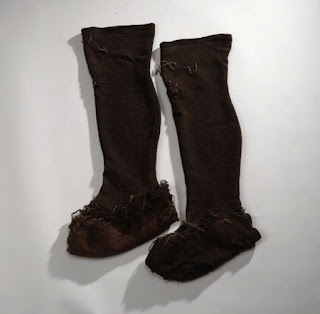
Stockings of dark brown wool, 609 mm in length, found at Gunnister. National Museums Scotland, H.NA 1043.

Two of the most famous pieces of extant early knitwear are the Gunnister stockings, so-called because they were found in 1951 on the naturally-mummified body of a late-17th- or early-18th-century man in a bog in Gunnister, Shetland.  Because of the anaerobic conditions of the burial, the man's clothing and possessions were remarkably well-preserved, although unlike other "bog bodies" the man's body itself was not.  Among many other woolen items of clothing -- he died in wintertime -- the man wore knitted stockings, caps (two), and gloves and carried a small knitted purse.  The feet of both stockings had been replaced some time before the man's death, one with a piece of fabric and the other with part of the leg of another knitted stocking.

The Gunnister man's possessions are now in the collection of the National Museums of Scotland.  The NMS writes of the stockings,

This pair of woollen knitted stockings, or long socks, was discovered on a man's body found at Gunnister in Northmavine in Shetland, in the late 17th century [sic]. The stockings have been knitted in stocking stitch and include 'clocks' -- woven or embroidered ornaments on the side of socks or stockings, rising up from the ankle. When he died, the man was wearing a coat, jacket, shirt, breeches, cap and stockings. Some of his possessions were a wooden pail, a horn spoon and a knife handle which could possibly have been used for preparing and eating food.

Jacqueline Fee's re-creation of the Gunnister stockings appeared in the January/February 2011 issue of "PieceWork" magazine (with a highlights article including numerous photos in the "PieceWork" newsletter of 7 February 2022), and "recipes" for knitting similar period stockings can be found at the websites of Drea Leed and Mara Riley.

Sunday, January 30, 2022

Stocking (1880-1920)

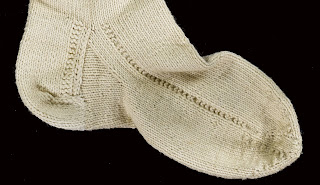
Knitted woman's stocking, cotton (1880-1920). Source: ModeMuseum Antwerpen, via Wikimedia Commons.

This lovely stocking has only the briefest of descriptions at the MoMu, noting only the initials JvL knitted in -- there are, however, more photos at the website, making it well worth a visit.

We can certainly assume that it is not meant to be worn, but is both knitting and darning practice!


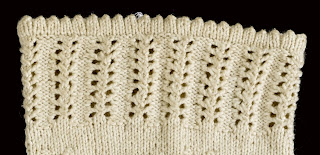
A by-this-period popular hemming method, using a row of eyelets to making a turning line, thereby creating a "scallop" effect.

Note the three different methods of creating initials -- with reverse stockinette at the top, and with eyelets, some plain and some emphasized by purl stitches.

Friday, January 28, 2022

Darning sampler (1880-1920)


Darning sampler (1880-1920), Source: ModeMuseum Antwerpen, via Wikimedia Commons.

Quite a variety of shapings and stitches here!  There are more photos at the MoMu website --

Sunday, January 23, 2022

Knitting sampler (18th century)


Detail of an 18th-century knitting sampler, probably German, in the collection of the Museum of Fine Arts, Boston, Elizabeth Day McCormick Collection, no.43.1022.

In the collection of the Museum of Fine Arts in Boston is a knitting sampler of lace patterns.  Unusually, this particular sampler is all of circular pieces knitted in fine cotton yarn, each joined to the next by some kind of small ligature, presumably also knitted, and then the whole chain is bound with a length of silk ribbon, the piece at each end also decorated with fluffy bows of the same red ribbon.  Each piece is a little under 14cm (not quite 6 in.); there appear to be thirty-one pieces altogether.  The Museum's description also notes that the sampler is backed with paper, though whether this is original or a conservation backing is not stated.  

Presumably this is a selection by the maker of doily patterns?

The MFA is quite strict about usage of their photographs of objects in their collection, and so I have included only a small cropped part in order to give an idea of the general shape, but it is well worth a virtual visit to see this fascinating piece and the maker's selection of patterns!

Saturday, January 22, 2022

Man's cap (18th-century Italy)

Detail of a "man's night cap" at the Museum of Fine Arts, Boston, no,38.1281.

The Museum of Fine Arts in Boston has in their collection what is described as a "man's night cap of natural linen knit in lace pattern," being a "conical cap with knitted ornament on top."  ("Ornament" is rather grand for the fairly-typical modest "tail" at the top of this cap, but there it is.)

The MFA is quite strict about usage of their photographs of objects in their collection, and so I have included only a small cropped part in order to show the lace stitch; it is well worth a visit even virtually to see the shape of this interesting cap, and to ponder whether it would be much use as a cap for sleeping in, or if perhaps "night cap" is a more general term for informal wear.

The cap looks, by the way, to have been knitted from the bottom up, possibly switching from right-side to wrong-side so that both the brim and the head sections show right-side-out.

Wednesday, December 29, 2021

What is a balaclava?

A balaclava is a knitted (or sometimes crocheted) head covering that is essentially a close-fitting cap combined with a tube-shaped neck, with an opening at the front for the face. It can be worn exposing only the eyes, or with the lower part of the opening at various points to cover or reveal the nose and mouth. The cap section may be pushed back off of the head in warmer conditions or as necessary. It is said to have originated sometime after the Battle of Balaclava in 1864, during which British troops wore handmade garments against the bitter cold because their own supplies had not arrived. The style of the cap is said to have been based on similar caps, the Uhlan worn by Polish and Prussian soldiers and the Templar cap worn by outdoor-sportsmen, earlier in the century. The earliest-known use of the term balaclava, though, was apparently in 1881; it was first called a helmet, and in pattern books of the early 20th century is often clarified as a "helmet (or balaclava)". Nevertheless, it is clearly a very practical garment for cold-weather wear, especially because it can be worn under larger hoods or protective helmets, and it is no surprise that it became a popular item to knit for soldiers and sailors during wartime.

(Franklin Habit writes about his search for a pattern, or even a logical description, of either the Uhlan or the Templar cap, and gives an updated pattern for Weldon's 1881 "Gent's Balaclava Cap" --

in his "Uh-la-la" post at Knitty. There is an "Uhlan Cap" as part of the instructions for "A Seaman's Outfit" in the Columbia Book of Yarns by Anna Schumacker, but this is dated 1915, long after the origin of the term, and clearly used there as simply a synonym for balaclava.)

Soldiers of the London Rifle Brigade with troops of the 104th and 106th Saxon Regiments during the so-called Christmas Truce, 1914. The soldier second from left at the front is wearing a balaclava; the soldier to his right is probably also. Non-commercial use permitted courtesy the Imperial War Museum, cat.Q 70075.
 

Knitted Comforts for Men on Land and Sea (Baldwin, 191?) provides two "helmet (or balaclava)" patterns, one with a split lower section that provides extra warmth to the front and back of the wearer's neck --


 and one with a plain ribbed neck --


(See also the post at "Knitting Now and Then" for some background information on this booklet and its pattern writer, Marjory Tillotson.)

The article "Knitting Comforts for the Troops" by Susan Strawn at PieceWork Magazine has another helmet pattern, with garter stitch flaps and a stockinette cap, from the Columbia Yarn company ca.1917.

This image, from the Jaeger Handknit series no.44, is courtesy the V&A's page on 1940s knitting, and a PDF of the pattern in modern terminology is available here. Interestingly, the Baldwin "helmet with flaps" pattern of a generation earlier says that "War Office Experts do not recommend apertures for the ears" which are especially vulnerable to the cold; presumably the development of radio technology in the ensuing twenty years made the additional openings necessary, one hopes not at the expense of the serviceman's ears.

Holly Shaltz has posted images from an American Red Cross booklet of three balaclava patterns for servicemen, and provided both transcriptions of the original "receipts" and updated instructions.

The Chelsea Bridge balaclava is undated but is most likely a 1940s pattern, as is the balaclava pattern from the "Guide to Knitting for Active Service" by the Australian Comforts Fund; the pattern in this link shows only the instructions rewritten in modern knitting terminology.

An American booklet of the 1940s that had at least one further edition post-war was Bucilla's "Warm Hand Knits for Servicemen".

See also the blog and online shop "Handmade WWI and WWII Reproduction Knits" for some interesting photos and background (though no patterns) on knitting for servicemen during those two wars.

Friday, October 29, 2021

Ladies' knitted square shawl (1892)

This pretty shawl from the 1892 "Delineator" magazine has a center field worked in blackberry stitch, still a popular choice for shawls etc. today. Somewhat unusually, a measurement for a finished section is given -- on the other hand, eighteen inches (45-46 cm) for the center, even allowing maybe half again for the borders, seems on the small side for a shawl, but perhaps it is meant for the shoulders.

Blackberry stitch is known by many names: trinity, bramble, raspberry, cluster. Slight variations abound, as one might expect!

Blackberry Stitch à la The Delineator

Over a multiple of 4 sts.

Row 1 (RS): *(K1, P1, K1) all in the same st, P3tog, rep from * to end.

Row 2: Purl.

Row 3: *P3tog, (K1, P1, K1) all in the same st, rep from * across. 

Row 4: Purl. 

Repeat these four rows for pattern. 

(A "Delineator" reader was apparently confused by this stitch, as a paragraph appeared in the "Answers to Correspondents" column of a later issue, viz., "[To] Miss M. R. : In knitting ladies' square shawl, first row knit 1, purl 1, and knit 1 out of 1 or next stitch, thus making 3, which you will find take the place of the 3 stitches purled together. This will neither widen nor narrow, but keep the shawl square. Treat the third row in the same manner" [v.41, p.xvi].)

Friday, October 22, 2021

Knitting needle and crochet hook gauges

"British knitting needle gauges. Showing an enamelled metal pair made by Milward, probably in the 1970s or 1980s, for sale in the UK, France, Germany and the Netherlands. They show imperial (wire gauge) and metric sizes."  Source: Wikimedia Commons, via user Storye book.

 For a fascinating and admirably thorough look at the history of needle and hook gauges, see the article "Early North American Knitting Needle Gauges" (parts one, two, and three!) by Susan Webster of Webster's Knitting Needle Notions in Australia.

(There are many other interesting articles on Webster's site -- click on the "Articles" tab, or just explore ...)

"British knitting needle gauges. They were made by Abel Morrell for their Aero knitting needles (right) and hooks (left). Both were probably manufactured before 1939. The right hand one is older, possibly 1920s. The left hand one is enamelled metal and has the cross fox trademark. Both are unmarked on the back." Source: Wikimedia Commons, via user Storye book.

Thursday, October 21, 2021

"Boudoir Jacket no.476" (1917)

This crocheted boudoir jacket pattern is from Corticelli's "Lessons in Knitting and Crochet, book 6," available at Antique Pattern Library.  A boudoir or bed jacket was a waist-length garment, often knitted or crocheted, worn over one's nightgown while reading or perhaps breakfasting in bed; it was most popular from about the 1920s to the 40s.  (Joanne Thompson theorizes, quite logically, that the garment's decline in popularity in the 1950s was due most likely to the rise in central heating, that an extra layer of warmth simply wasn't needed any more.)

Fatima at Crochetology by Fatima has a long post detailing her making of this boudoir jacket.

In the Winter 2021 issue of "PieceWork" magazine, Pat Olski has rewritten the jacket pattern into modern format, adding to very handsome effect the Crocheted Coat Fastener no.321a from Corticelli's "Lessons in Crochet, book 2," also available in its original format at Antique Pattern Library.


 The boudoir jacket in "Weldon's Practical Crochet, 194th series" (no.423, vol.36) from about the same date,

is of very similar construction, though rather more dégagé in appearance.  Note also the similarity between these particular boudoir jackets and the hug-me-tight worn by Trini Alvarado as Meg in the 1994 film of "Little Women" which, if it is indeed an authentic 1860s garment, would certainly be an ancestor --