Showing posts with label PieceWork (magazine). Show all posts

Thursday, February 10, 2022

The Gunnister Stockings (late 17th century)

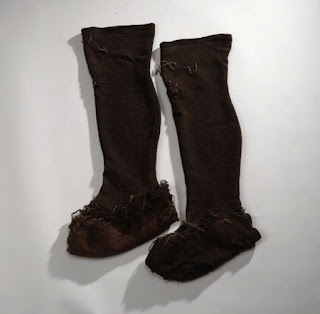
Stockings of dark brown wool, 609 mm in length, found at Gunnister. National Museums Scotland, H.NA 1043.

Two of the most famous pieces of extant early knitwear are the Gunnister stockings, so-called because they were found in 1951 on the naturally-mummified body of a late-17th- or early-18th-century man in a bog in Gunnister, Shetland.  Because of the anaerobic conditions of the burial, the man's clothing and possessions were remarkably well-preserved, although unlike other "bog bodies" the man's body itself was not.  Among many other woolen items of clothing -- he died in wintertime -- the man wore knitted stockings, caps (two), and gloves and carried a small knitted purse.  The feet of both stockings had been replaced some time before the man's death, one with a piece of fabric and the other with part of the leg of another knitted stocking.

The Gunnister man's possessions are now in the collection of the National Museums of Scotland.  The NMS writes of the stockings,

This pair of woollen knitted stockings, or long socks, was discovered on a man's body found at Gunnister in Northmavine in Shetland, in the late 17th century [sic]. The stockings have been knitted in stocking stitch and include 'clocks' -- woven or embroidered ornaments on the side of socks or stockings, rising up from the ankle. When he died, the man was wearing a coat, jacket, shirt, breeches, cap and stockings. Some of his possessions were a wooden pail, a horn spoon and a knife handle which could possibly have been used for preparing and eating food.

Jacqueline Fee's re-creation of the Gunnister stockings appeared in the January/February 2011 issue of "PieceWork" magazine (with a highlights article including numerous photos in the "PieceWork" newsletter of 7 February 2022), and "recipes" for knitting similar period stockings can be found at the websites of Drea Leed and Mara Riley.

Thursday, October 21, 2021

"Boudoir Jacket no.476" (1917)

This crocheted boudoir jacket pattern is from Corticelli's "Lessons in Knitting and Crochet, book 6," available at Antique Pattern Library.  A boudoir or bed jacket was a waist-length garment, often knitted or crocheted, worn over one's nightgown while reading or perhaps breakfasting in bed; it was most popular from about the 1920s to the 40s.  (Joanne Thompson theorizes, quite logically, that the garment's decline in popularity in the 1950s was due most likely to the rise in central heating, that an extra layer of warmth simply wasn't needed any more.)

Fatima at Crochetology by Fatima has a long post detailing her making of this boudoir jacket.

In the Winter 2021 issue of "PieceWork" magazine, Pat Olski has rewritten the jacket pattern into modern format, adding to very handsome effect the Crocheted Coat Fastener no.321a from Corticelli's "Lessons in Crochet, book 2," also available in its original format at Antique Pattern Library.


 The boudoir jacket in "Weldon's Practical Crochet, 194th series" (no.423, vol.36) from about the same date,

is of very similar construction, though rather more dégagé in appearance.  Note also the similarity between these particular boudoir jackets and the hug-me-tight worn by Trini Alvarado as Meg in the 1994 film of "Little Women" which, if it is indeed an authentic 1860s garment, would certainly be an ancestor --

Thursday, February 25, 2021

A child's chest protector


Ann Budd updated the pattern for this child's chest protector from vol.7 of Weldon's Practical Needlework -- her version is published free on the "Piecework" magazine blog.

Budd's version is whip-stitched together at the sides, probably more practical for a modern child than the tabard-like original -- presumably it tied so that it would fit over however many layers in which the Victorian child was dressed that particular day, before being sent outdoors!

Tuesday, January 28, 2020

Prince Harald's knitted jumper

The knitted jumper worn by little Prince Harald when his family fled Norway just ahead of the Nazi invasion in 1940 inspired many a patriotic Norwegian, and Norwegians in spirit, to knit their own. The stitch pattern is a traditional Norwegian one, possibly from Hallingdal; it is also found in traditional Faroese designs and Latvian mittens.  Arne and Carlos, in the video below, call the pattern "Dovre," explaining that they do so because of a 1960s-era booklet for a cardigan using that name, which name "stuck in their heads" but that is not the traditional name for it, if there is one at all.  It is sometimes called the "chess" pattern in English, for its resemblance to the game board.

Laura Ricketts published a version of Prince Harald's red-and-white jumper in the January/February 2015 issue of "PieceWork" magazine, and there is also one (in Norwegian) by Nina Granlund Sæther, both available for purchase via Ravelry.

Tasha of By Gum, By Golly came up with a more feminine version that she calls "The Princess Harald Sweater" and blogged about it here.

The then-three-year-old Prince Harald of Norway. The pin on his cap was one of those sold by the Foreningen Norden (The Nordic Associations) at the Holmenkollen ski festival that year in support of war-torn Finland. Photos by Anders Beer Wilse, 1940; both photos, Wikimedia Commons.

In this video, Norwegian knitwear designers and educators Arne & Carlos talk about the "Dovre" stitch pattern --


Thursday, January 31, 2019

"Polka Jacket Trimmed with Imitation Ermine" (1856)


The term "polka jacket" is rarely defined in period sources, but derives not from the dance but from the military jacket of the same name.

The General Regulations for the Military Forces of the State of New York (1870) describes their version, one of the two "Uniform Coat[s] for the Non-Commissioned Officers, Musicians and Privates of the National Guard Infantry" as "differing from the chasseur jacket [described meticulously in the article's previous paragraph], in being without skirt, but extending without seam five inches below the hip; without opening or buttons behind, and round edge in front" (p.252).  Women's knitted polka jackets seem to be fairly consistent in their details -- a single-breasted close-fitting jacket, usually collarless, with long sleeves and smooth skirt with rounded fronts, often trimmed, as this one is, in faux ermine, and apparently always worked in brioche stitch, possibly because brioche's inherent stretchiness made it easier to fit smoothly.

Here is the full pattern from the January-June 1856 issue of "Godey's Lady's Magazine" --

 A similar polka jacket from an 1849 issue of "Family Friend" was transcribed by Carol Rhodes and appears in modern-pattern format in Helen Bonney's article in the January/February 2013 issue of "PieceWork" magazine.

Friday, May 25, 2018

"Mittens Knitted on Two Needles" (1876)

"Mittens Knitted on Two Needles" in Regia 4-fädig in color 1991 (grey heather) and Paton's Kroy in "Muslin" (cream). The crochet edging was improvised. A handsome and comfortable fingerless mitt. Photos from A Bluestocking Knits.

The terms "mitts" and "mittens," though today we usually use to refer to, respectively, fingerless-but-thumbed gloves and those with one fully-enclosed space each for thumb and all of the fingers together, seem to have been used fairly interchangeably in the early days of published knitting patterns, as here in the "Mittens Knitted on Two Needles" by Miss H.P. Ryder, in her Winter Comforts and How to Knit Them (1876). The Misses Ryder, sisters Elizabeth and Henrietta, were both writers of knitting "receipts" during the middle and later parts of the Victorian period; they were from Richmond, in Yorkshire.

The thumb is shaped with short rows. Note, too, this early use of the slipped-stitch selvage.

Uploaded to Archive.org courtesy the Richard Rutt Collection at the University of Southampton.

See also the article "The Richmond Glove and its Creator, Henrietta Pulleine Ryder" by Lesley O'Connell Edwards in the March/April 2018 issue of Piecework (Ravelry link here) which has background information on the Ryder sisters and an updated pattern for Miss Henrietta's Richmond Glove, which is a layered duo -- knitted in one piece -- of glove and fingerless mitt.

A blog post by Ann Kingstone about the Ryder sisters and the Richmond Glove is here.

The original ribbed top edge of the Mitten Knitted on Two Needles, before sewing up the side seam or edging the thumb.