
An unknown young knitter, possibly British from her "drawing-room" style of holding her right needle.

The Royal Victoria Knitting Book : containing an assortment of the most elegant patterns for hats, hoods, feathers, and bonnets, published in London by W. Clark, possibly in 1850, gives patterns for some very charming knitted hats and bonnets indeed. The Victoria Knitting Book was published in installments; the copy at the Internet Archive linked above contains pages 85-96 (breaking off right in the middle of a pattern!); the full book can be seen here, courtesy of the Richard Rutt Collection at the University of Southampton. Other installments focused on lace edgings and insertions, cuffs and collars, doilies and antimacassars, polkas, stockings, shawls, etc.
Here is the pattern for the exquisitely lacy hat No. 40, at top in the image above --

The "curtain" is the part of a bonnet or hat that covers the back of the wearer's neck.

This "block for a slumber robe" is the earliest-known appearance of what later became known as the granny square. It is from Butterick's The Art of Crocheting (1891).
Thanks to Hannah at HanJan Crochet for her post on the history of the granny square!

"The Hempstead Sweater," a sporty number from The Columbia Book of Yarns by Anna Schumacker (Philadelphia : Columbia Yarns, 1908) -- the pattern begins on page 125. The sleeve width has decreased remarkably since the Delineator's sweater not even ten years earlier, but much emphasis is still given to drawing in a narrow waist.


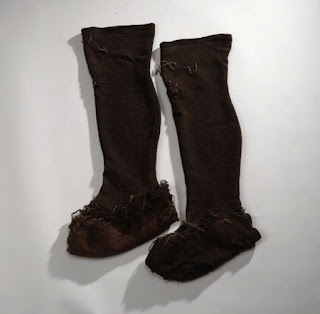
Two of the most famous pieces of extant early knitwear are the Gunnister
stockings, so-called because they were found in 1951 on the
naturally-mummified body of a late-17th- or early-18th-century man in a bog in Gunnister, Shetland. Because of the anaerobic conditions of the burial, the man's clothing and possessions were remarkably well-preserved, although unlike other "bog bodies" the man's body itself was not. Among many other woolen items of clothing -- he died in wintertime -- the man wore knitted stockings, caps (two), and gloves and carried a small knitted purse. The feet of both stockings had been replaced some time before the man's death, one with a piece of fabric and the other with part of the leg of another knitted stocking.

The Gunnister man's possessions are now in the collection of the National Museums of Scotland. The NMS writes of the stockings,
This pair of woollen knitted stockings, or long socks, was discovered on a man's body found at Gunnister in Northmavine in Shetland, in the late 17th century [sic]. The stockings have been knitted in stocking stitch and include 'clocks' -- woven or embroidered ornaments on the side of socks or stockings, rising up from the ankle. When he died, the man was wearing a coat, jacket, shirt, breeches, cap and stockings. Some of his possessions were a wooden pail, a horn spoon and a knife handle which could possibly have been used for preparing and eating food.
Jacqueline Fee's re-creation of the Gunnister stockings appeared in the January/February 2011 issue of "PieceWork" magazine (with a highlights article including numerous photos in the "PieceWork" newsletter of 7 February 2022), and "recipes" for knitting similar period stockings can be found at the websites of Drea Leed and Mara Riley.

Knitted woman's stocking, cotton (1880-1920). Source: ModeMuseum Antwerpen, via Wikimedia Commons.
This lovely stocking has only the briefest of descriptions at the MoMu, noting only the initials JvL knitted in -- there are, however, more photos at the website, making it well worth a visit.
We can certainly assume that it is not meant to be worn, but is both knitting and darning practice!
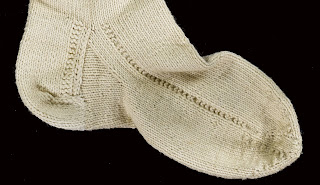
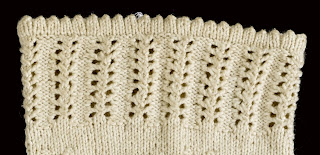
A by-this-period popular hemming method, using a row of eyelets to making a turning line, thereby creating a "scallop" effect.

Note the three different methods of creating initials -- with reverse stockinette at the top, and with eyelets, some plain and some emphasized by purl stitches.


Quite a variety of shapings and stitches here! There are more photos at the MoMu website --

In the collection of the Museum of Fine Arts in Boston is a knitting sampler of lace patterns. Unusually, this particular sampler is all of circular pieces knitted in fine cotton yarn, each joined to the next by some kind of small ligature, presumably also knitted, and then the whole chain is bound with a length of silk ribbon, the piece at each end also decorated with fluffy bows of the same red ribbon. Each piece is a little under 14cm (not quite 6 in.); there appear to be thirty-one pieces altogether. The Museum's description also notes that the sampler is backed with paper, though whether this is original or a conservation backing is not stated.
Presumably this is a selection by the maker of doily patterns?
The MFA is quite strict about usage of their photographs of objects in their collection, and so I have included only a small cropped part in order to give an idea of the general shape, but it is well worth a virtual visit to see this fascinating piece and the maker's selection of patterns!

The Museum of Fine Arts in Boston has in their collection what is described as a "man's night cap of natural linen knit in lace pattern," being a "conical cap with knitted ornament on top." ("Ornament" is rather grand for the fairly-typical modest "tail" at the top of this cap, but there it is.)
The MFA is quite strict about usage of their photographs of objects in their collection, and so I have included only a small cropped part in order to show the lace stitch; it is well worth a visit even virtually to see the shape of this interesting cap, and to ponder whether it would be much use as a cap for sleeping in, or if perhaps "night cap" is a more general term for informal wear.
The cap looks, by the way, to have been knitted from the bottom up, possibly switching from right-side to wrong-side so that both the brim and the head sections show right-side-out.