


Lady's riding habit shirt of linen, England, ca.1800. Courtesy V&A, accession no. T.104-1966.
The habit shirt was so called because it was originally worn by a lady under her riding habit. Wiktionary defines it as "a thin muslin or lace undergarment worn by women on the neck and shoulders, under the dress." It seems often to have been sleeveless, as in the V&A garment above. We might today, or yesterday perhaps, call this particular kind a dickey.
The term when it referred to a knitted garment seems generally not to have been something worn under the dress, but over it, for example a sontag -- indeed, Mrs. Pullan refers to her sontag as "a sort of woolen habit-shirt," presumably because it was a similar shape and worn in the same place on the body, not because it particularly resembled a habit shirt.
See other habit shirts in the John Bright Collection.

The 1886 edition of Mrs. Croly's Knitting and Crochet gives a pattern for a "cross-over," which anyone who does even a little bit of historical knitting will recognize is the same garment as a sontag. This particular pattern will result in a triangle with a blunted bottom, which will be the back of the garment, with opposing right-angle triangles worked at the sides forming the "cross-over" pieces, more-or-less the standard sontag shape.

Curiously, Mrs. Croly gives instructions to trim the garment, but not how to secure it while wearing.
Note also that the method of increasing the size is simply to use larger wool and needles!

The book is geared towards ladies who find themselves, through no fault of their own, surely, in distressed circumstances, and need a respectable source of income. (The "pleasure" part of the needlework is clearly subsidiary to the "profit", but it is kind of the author to emphasize that pleasure can be taken in work done well.) The first part of the book discusses the practicalities of making and selling various kinds of needlework, including which kinds are more marketable than others due to fashion trends, etc., and the last part lists work societies across Britain that sold needlework on commission (some of whom required references -- "one from a clergyman" -- this being 1886, after all), some by post, others in person. The middle part of the book is patterns for knitted items, crochet, and "miscellaneous items" -- fringes, balls and reins for children, penwipers*, etc. etc. While the knitting "recipes" do not give much idea of gauge, they do at least give needle sizes along with the suggested wools, so that the knitter does get some idea of the intended gauge.
There is, alas, not a single illustration in the book.

*When one finished writing with either a dip pen or a fountain pen, it had to be wiped clean so that the leftover ink didn't dry up and clog the nib. Penwipers could come in a dizzying array of forms, from ones very like brush boot scrapers to folded fans to a (rather frightening) doll's head or felted or sewn animals atop the circles of fabric that were the actual wiping surface. (And, yes, the succulent Kalanchoe marmorata is called "penwiper plant" due to its resemblance to the folded and stacked circles of fabric out of which penwipers were often made!)


The Royal Victoria Knitting Book : containing an assortment of the most elegant patterns for hats, hoods, feathers, and bonnets, published in London by W. Clark, possibly in 1850, gives patterns for some very charming knitted hats and bonnets indeed. The Victoria Knitting Book was published in installments; the copy at the Internet Archive linked above contains pages 85-96 (breaking off right in the middle of a pattern!); the full book can be seen here, courtesy of the Richard Rutt Collection at the University of Southampton. Other installments focused on lace edgings and insertions, cuffs and collars, doilies and antimacassars, polkas, stockings, shawls, etc.
Here is the pattern for the exquisitely lacy hat No. 40, at top in the image above --

The "curtain" is the part of a bonnet or hat that covers the back of the wearer's neck.

This "block for a slumber robe" is the earliest-known appearance of what later became known as the granny square. It is from Butterick's The Art of Crocheting (1891).
Thanks to Hannah at HanJan Crochet for her post on the history of the granny square!

"The Hempstead Sweater," a sporty number from The Columbia Book of Yarns by Anna Schumacker (Philadelphia : Columbia Yarns, 1908) -- the pattern begins on page 125. The sleeve width has decreased remarkably since the Delineator's sweater not even ten years earlier, but much emphasis is still given to drawing in a narrow waist.


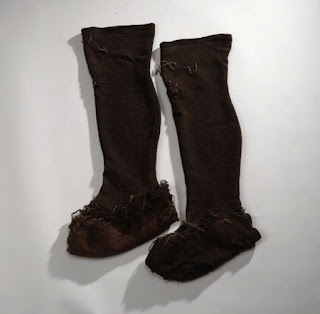
Two of the most famous pieces of extant early knitwear are the Gunnister
stockings, so-called because they were found in 1951 on the
naturally-mummified body of a late-17th- or early-18th-century man in a bog in Gunnister, Shetland. Because of the anaerobic conditions of the burial, the man's clothing and possessions were remarkably well-preserved, although unlike other "bog bodies" the man's body itself was not. Among many other woolen items of clothing -- he died in wintertime -- the man wore knitted stockings, caps (two), and gloves and carried a small knitted purse. The feet of both stockings had been replaced some time before the man's death, one with a piece of fabric and the other with part of the leg of another knitted stocking.

The Gunnister man's possessions are now in the collection of the National Museums of Scotland. The NMS writes of the stockings,
This pair of woollen knitted stockings, or long socks, was discovered on a man's body found at Gunnister in Northmavine in Shetland, in the late 17th century [sic]. The stockings have been knitted in stocking stitch and include 'clocks' -- woven or embroidered ornaments on the side of socks or stockings, rising up from the ankle. When he died, the man was wearing a coat, jacket, shirt, breeches, cap and stockings. Some of his possessions were a wooden pail, a horn spoon and a knife handle which could possibly have been used for preparing and eating food.
Jacqueline Fee's re-creation of the Gunnister stockings appeared in the January/February 2011 issue of "PieceWork" magazine (with a highlights article including numerous photos in the "PieceWork" newsletter of 7 February 2022), and "recipes" for knitting similar period stockings can be found at the websites of Drea Leed and Mara Riley.